

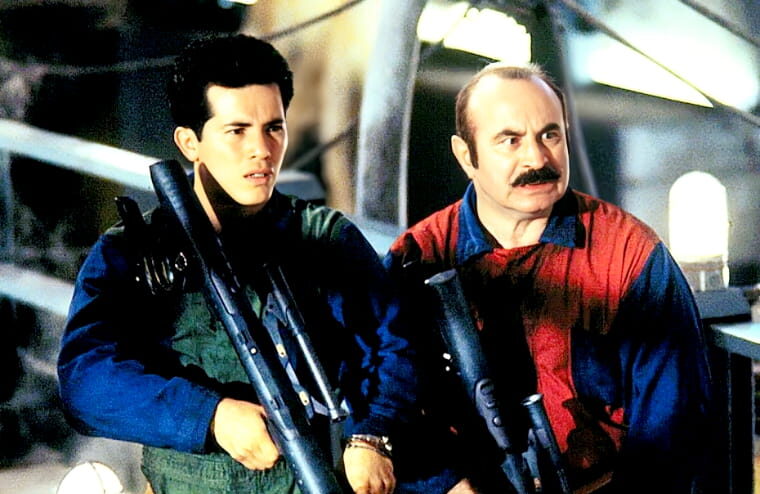
I have read much about the nightmarish production of the 1993 “Super Mario Bros.” movie. Scripts were constantly rewritten, the cast/crew openly rebelled against directors Rocky Morton and Annabel Jankel, and chaos reigned supreme. Each of the main actors who starred in this film speaks of their experiences as if they had witnessed the horrors of war firsthand. It bombed at the box office and appeared on many “Worst Of” lists that year. In a 2011 interview with The Guardian, Bob Hoskins, the man who played Mario, was asked three questions: “What is the worst job you’ve done?” “What has been your biggest disappointment?” and “If you could edit your past, what would you change?” His answer to all three was “Super Mario Bros.” Even with all that and the knowledge I possess, I still cannot tell you exactly how “Super Mario Bros.” turned out the way it did.
With each new entry, this column becomes a defense of the most maligned movies ever made. That was not by design, but I am often drawn to weird cinema. Anything that deviates from the norm is bound to earn detractors and admirers in equal numbers. “Super Mario Bros.” probably deserves a good chunk of the criticism it received upon its initial release, mainly because it doesn’t resemble the “Super Mario” games in the slightest. Remember those colorful, whimsical games about a cute cartoon character jumping around in a fairytale-like kingdom? Well, this is a gritty dystopian sci-fi picture loaded with street punks in bondage gear and hideous dinosaur mutants. Still, I cannot help but like (even love) this movie. Infamous cinematic “disasters” often age well because, over time, we can look back and appreciate the insane risks taken. And you can’t argue that “Super Mario Bros.” took some insane risks.
Around 1990, producers Roland Joffé (the director of “The Killing Fields” and “The Mission”) and Jake Eberts, along with their company Lightmotive, sought the rights to make a “Super Mario Bros.” movie from Nintendo for just $2 million. Lightmotive offered creative control and full merchandising rights to the gaming giant, something the major studios wouldn’t give them. But Nintendo saw Mario as too big to fail and approached the whole thing as an experiment. “They looked at the movie as some sort of strange creature, [intrigued] to see if it could walk or not,” said Joffé about the deal.
At one point, Dustin Hoffman was interested in making a Mario movie with Barry Levinson. Danny DeVito was also considered to direct and star. Arnold Schwarzenegger turned down the role of Bowser, and Tom Hanks was briefly attached to the role of Luigi. The timing of this post would lead you to believe this article is an April Fool’s prank, but I can assure you that this info, though slightly varied from source to source, is accurate. Screenwriter Barry Morrow, of “Rain Man” fame, wrote the first draft so similar to the previous work that it was nicknamed “Drain Man” by the production staff. The team of Jim Jennewein and Tom S. Parker, who eventually wrote “The Flintstones” movie, wrote a light-hearted fairy-tale parody. From the sounds of it, that draft was close to the tone and world of Mario. Of course, that was rejected. Harold Ramis turned down the chance to direct despite being a fan of the games. Greg Beeman was attached but let go after the failure of his film, “Mom and Dad Save the World.”
For reasons I still don’t understand and probably never will, Joffé saw cyberpunk TV classic “Max Headroom” and decided that was the approach he wanted for his Mario movie. “Max Headroom” co-creators Rocky Morton and Annabel Jankel were brought aboard to direct. Morton, Jankel, and Joffé agreed that their movie should have a dark tone similar to that of Tim Burton’s “Batman.” Personally, I would argue that a dark tone makes sense for a brooding detective who strikes fear into criminals, but not so much for a portly plumber who jumps over turtles. But Joffé disagreed and said, “This wasn’t Snow White and the Seven Dinosaurs […] The dinosaur world was dark. We didn’t want to hold back.” Again, he was making a Mario movie.
My intent for writing this article was to praise this movie for the bug-nutty creation that it is, not to be a definitive history of its troubled production. Going briefly into the production of a film is something I very much enjoy doing. However, there’s no “briefly” when it comes to “Super Mario Bros.” To keep things short, check out The Super Mario Bros. Movie Archive, a website that can offer you far more on the history of the movie than I ever could. I’ll keep it at this: script changes and rewrites were ordered by the studio unbeknownst to basically everyone involved. This led to conflict and explains some of the plot inconsistencies. However, if things had gone smoothly, “Super Mario Bros.” would still be a deeply bizarre movie. In no other picture does a princess have a conversation with a hunk of slimy fungus.
66 million years ago, a meteorite crashed into Earth, splitting the world into two dimensions. Surviving dinosaurs escaped into one, evolved into a humanoid species, and built a city called “Dinohattan.” That is the basic premise of this Super Mario movie, which tells you what you’re getting into. Now, ignoring its connection to Mario, all of this is cool. Dinohattan was created by David Snyder, who was the production designer on “Blade Runner.” Constructed in the deserted Ideal Cement Co. plant in Wilmington, North Carolina, Dinohattan is a genuine marvel. It’s totally alien yet feels lived in. Art Director Walter P. Martishius said, “Koopa gets a single glimpse of Manhattan at the beginning of the movie”. This inspires Koopa to recreate Dinohattan, but “he didn’t get it quite right. The place is twisted, off balance, different, and he doesn’t even know it.” You see that vision in every moment spent in that city. If for no other reason, “Super Mario Bros.” is worth watching for its Dinohattan scenes.
But there are actually many reasons to watch “Super Mario Bros.” Lead creature designer Patrick Tatopoulos (also known for “Bram Stoker’s Dracula”) created all sorts of impressive dinosaurs and mutants for this production, including a brilliant “Yoshi” operated by nine puppeteers. In no normal film would Bob Hoskins and John Leguizamo be cast as brothers, but it’s clear that this is no normal movie. And despite sounding very odd on paper, the duo is actually very likable. Even though the two actors (and all of the actors) hated working on the film, Hoskins and Leguizamo bring a fun energy that isn’t too far removed from how I see the Mario Brothers. Dennis Hopper is an absolute hoot as Koopa, played here as a slimy politician with a haircut that’s either the worst or best of all time. Rockabilly madman Mojo Nixon appears as Toad, here portrayed as a protest singer turned into a mutant lizard with a harmonica. Movies are magical.
Truthfully, I don’t have much to say about the negatives. That’s not because the film is flawless (we have firmly established that it’s not) but because none of them bother me. Had it not been for the constant script rewrites and growing tension between everyone involved, they might’ve had something really special on their hands. Obviously, it still would’ve bombed simply because it had nothing to do with its popular source material. But I believe its cult audience would have been even more substantial than it already is.
“Super Mario Bros.” is a highly creative sci-fi comedy with many great ideas and fascinating visuals. The problem is that Mario’s connection simultaneously guarantees it will never be forgotten while also damning it to unfair comparisons. Mario fans will be disappointed, but you know who may probably dig it? Fans of “The Adventures of Buckaroo Banzai Across the 8th Dimension,” another nutty sci-fi romp about inter-dimensional weirdness. Taken as just a far-out standalone movie, “Super Mario Bros.” is a good time.
“The Super Mario Galaxy Movie,” the second in a series of animated Mario films, has just been released at the time of writing. I’ve yet to see it, though I suspect I will enjoy it for what it is. Mario meant a lot to me growing up, so I’m not immune to the charms of a big blockbuster adaptation of it. Are these new Mario movies better than “Super Mario Bros.? I honestly cannot say. Having seen the first of these animated Marios, I can certainly say they’re more faithful. But better? “Super Mario Bros.” is such an insane piece of pop culture that only could’ve happened at that exact moment in time. It ain’t Mario, but I’m glad it exists. We always need more weird movies.