


If you’ve ever read a review or analysis of any Dario Argento movie, you know the term “dream logic.” Generally, this means that the film prioritizes surreal atmosphere and eerie imagery over traditional storytelling. When a film is driven by dream logic, the viewer must abandon rationality and accept the nightmare as it unfolds. Argento’s “Suspiria” is a prime example of this mentality. If you dissect that movie with a skeptic’s reason, it comes apart. But if you experience it as a fairy tale, it’s quite effective. Some folks reject this way of thinking entirely. They believe that a film must adhere to conventional logic in order to work. Of course, that is a valid way to approach cinema and storytelling. But if you can’t accept dream logic, there are some films you shouldn’t bother with.
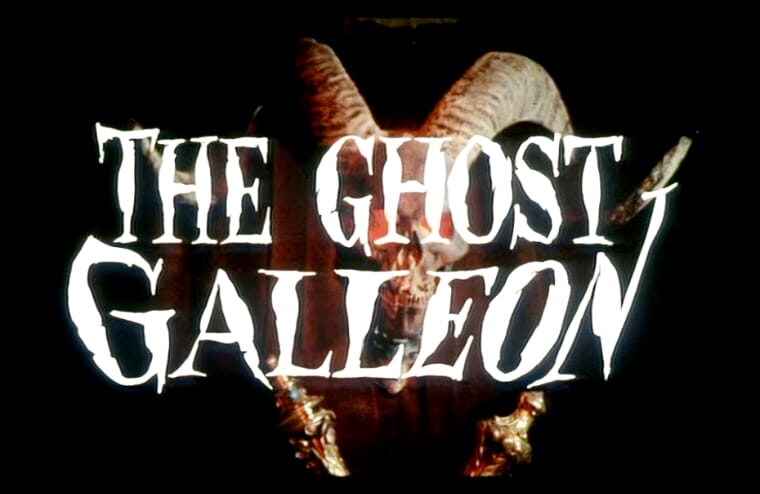
“The Ghost Galleon” is one such picture. Its story concerns a super-secret bikini modeling publicity stunt gone wrong and leads to a (you guessed it) ghost galleon inhabited by Satan-worshipping Knights Templar. Here, the Knights Templar are eyeless mummies who search for their victims by sound. I can’t imagine any bikini modeling venture requiring that level of secrecy, but it really doesn’t matter. At the end of the day, the story is there to ensure that living targets cross paths with the undead. Within the script, one character states that they have crossed over into another dimension. That is as true for the viewer as it is for the characters. What we are seeing is not reality as we know it. Even before the ghouls show up, everything feels unnatural. Some of that may be unintentional (the dub I watched certainly added to that weird feeling), but it all works within the living nightmare this film sets out to create.
Admittedly, one of my major blind spots (pun intended) in horror is the “Blind Dead” series by Spanish director Amando de Ossorio. Beginning with “Tombs of the Blind Dead” in 1972, the series has amassed a considerable fanbase and inspired numerous heavy metal songs. “The Ghost Galleon” is the third of four installments, and it’s my first encounter with the blind dead. For whatever reason, I just never took the time to watch this series. Considering that obscure horror used to be my bread-and-butter, it’s strange that the Blind Dead eluded me for so long. After “The Ghost Galleon,” I plan to rectify that. Perhaps I may even cover the whole series in the near future. But at the moment, we’ll stick with “The Ghost Galleon.”
In preparation for this piece, I skimmed a few reviews of “The Ghost Galleon.” From what I can gather, this is not a well-regarded movie. It’s definitely a little cheesy at times (a boon in my book), and there’s an uncomfortable sexual assault scene that really doesn’t contribute a whole lot. That said, those elements are not unusual for a 1970s exploitation movie. For better or for worse, you expect those things in this kind of movie. What separates “The Ghost Galleon” from many such chillers from the era is a sense of nautical dread.
Instead of traditional music, we have a soundscape straight from Davy Jones’s locker: coffins creaking, wind howling, and other unfathomable noises give the impression that something is always lurking. When there is music, it’s the unholy chanting of the ghouls. People have criticized the low-budget look of this movie (including the director), but the sets and lighting are beautifully haunting. This is a richly atmospheric movie designed to be as chilling as possible. Not to be scared would be impolite.
Based on this film alone, I can see why the Blind Dead became the iconic shamblers that they are. Ancient, decayed, and skeletal in appearance, they are a fright to behold. A few critics have pointed out that they are slow enough to outrun. To me, it’s clear with the supernatural abilities that they will catch up to you no matter how fast you run. There’s no escaping the inevitable, and the Blind Dead are inevitable. These are some fantastic monsters, and I would recommend “The Ghost Galleon” just for them.
Even though I personally enjoyed “The Ghost Galleon,” I can understand why it may not appeal to everyone. This film operates on the aforementioned dream logic that may be completely anathema to some of you. Script, characters, and reason are jettisoned in favor of that ghostly atmosphere. I see it as being the cinematic equivalent of a campfire story. You won’t find depth or conventional logic here. But if spectral scares and maritime morbidity are enough for you, “The Ghost Galleon” is worth a watch. And if you love John Carpenter’s “The Fog,” you may find something here to chill the blood.

- The Phibes Philes: Friday The 13th On The NES – The Misunderstood Video Game Classic - June 22, 2026
- The Phibes Philes: Wishmaster – Movie Review - June 12, 2026
- The Phibes Philes: The Eraser – Batman’s Forgotten Foe - May 27, 2026