


On the poster for the 1990 feature film “DuckTales the Movie: Treasure of the Lost Lamp,” the beloved cartoon character/adventure capitalist is seen wearing a brown fedora and exploring an ancient tomb. The color scheme and logo font were reminiscent of posters from another iconic series. Indiana Jones was obviously meant to be evoked. We could call it a “rip-off,” a “parody,” or (perhaps most accurately) an “homage.” No matter what word you use to describe it, there’s no denying the influence of Dr. Henry Jones, Jr. and the trilogy of globetrotting action pictures he starred in. (This was before the last two installments, of course.)Even as a child, the connection was clear. Scrooge McDuck was a Jones imitator.
Oh, how wrong I was! Now older, wiser, and slightly obsessed with both adventurers, I’ve come to realize that perhaps it was the other way around. Indiana Jones will forever be one of my favorite heroes in the realm of fiction. Still, it’s well known that creators George Lucas and Steven Spielberg were influenced by the adventure serials of the 1930s and 1940s. Homage was the foundation on which Indiana Jones was built. Even if Scrooge McDuck were purely borrowing from Indy, that would be entirely okay. But that ain’t the case! Scrooge was hunting for treasure long before Indy cracked his first whip.
Created in 1947 by the legendary cartoonist Carl Barks, Scrooge McDuck was initially created as a one-off character in a Donald Duck comic called “Christmas on Bear Mountain.” Scrooge was first written as a play on (you guessed it) Ebeneezer Scrooge, a role he would return to in the wonderful 1983 short, “Mickey’s Christmas Carol.” For the next four years, Barks experimented with Scrooge’s personality within the pages of Donald Duck comics. Eventually, Scrooge would evolve from a miserable miser to an action hero. The Richest Duck in the World gained his starring role in comics that emphasized adventure over straight comedy. Scrooge would increase his wealth through treasure hunting and exploring. Like Indiana Jones, Scrooge McDuck goes to faraway countries and exotic lands in search of rare artifacts.
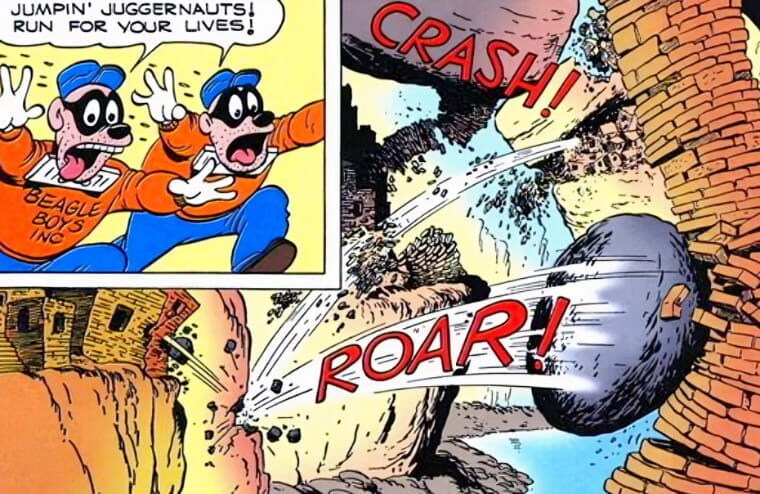
Based on that alone, you could perhaps see how Scrooge may have possibly been an influence on Indy. However, adventurers have existed long before both of our heroes. Where things really get interesting is in Uncle Scrooge #7, with a story called “The Seven Cities of Cibola.” Published in 1954, it involves Scrooge and his nephews venturing to the lost Seventh City of Cibola. There, they encounter a statue made of emerald. However, they leave it within the city after observing that traps surround it. Unfortunately, the Beagle Boys (longtime enemies of Scrooge) take no such caution and take the statue, activating a trap that sends a boulder rolling after them.
Unless you have been living under a boulder yourself, you will instantly note the similarities between that sequence and the famous opening to “Raiders of the Lost Ark.”
Some details are off, but the basic concept is the same: an ancient idol activates a boulder-based booby trap when snatched from its pedestal. We could claim it’s a coincidence, but both Lucas and Spielberg are known to be familiar with Scrooge McDuck. Lucas wrote the introduction to the compilation “Walt Disney’s Uncle Scrooge McDuck: His Life and Times.” At the same time, Spielberg said that Scrooge was one of his favorite characters in a documentary called “The Scrooge Mystery.” Edward Summer, the man behind the aforementioned compilation, claimed that Lucas told him that the boulder scene was a conscious homage to Scrooge.
However, neither Spielberg nor Lucas has publicly acknowledged Scrooge’s supposed influence on Indiana Jones and/or “Raiders of the Lost Ark.” Even if Summer’s account is accurate, Spielberg claims he came up with the boulder bit in the featurette “Indiana Jones: Making the Trilogy.” We don’t know if he intended for that scene to be a tribute to Scrooge. Similarly, a DVD release of the Lupin III film “The Castle of Cagliostro” features a “quote” from Spielberg on its cover. “One of the greatest adventure movies of all time,” he reportedly said. But I’ve been searching for decades now, and I have never been able to find a credible source for that quote. While I do agree that “The Castle of Cagliostro” is one of the greatest adventure movies of all time, we don’t know if Spielberg actually said that. It seems to be the same case with the Scrooge/Indiana Jones connection, even if there’s a little more evidence to support that claim.
Do I personally believe that Spielberg and/or Lucas were inspired by Scrooge when they created Indy? Absolutely, if only on a subconscious level. Indiana Jones is an amalgamation of all the adventure stories that inspired them in their youth. Scrooge is far from the only figure that helped create Jones, but his feathery DNA is certainly there somewhere. The latter homage from the “DuckTales” movie poster feels like an old pro tipping his hat to the new generation. In a sense, I believe they inspired each other. And quite honestly, they ought to inspire the rest of us. Guys like Indy and Scrooge embody that adventurous spirit we all possess. We should all give in to that spirit now and then. Go out there and live your own adventures. Be a Scrooge McDuck. Be an Indiana Jones. Put on that fedora and go forth into the unknown.

- The Phibes Philes: Friday The 13th On The NES – The Misunderstood Video Game Classic - June 22, 2026
- The Phibes Philes: Wishmaster – Movie Review - June 12, 2026
- The Phibes Philes: The Eraser – Batman’s Forgotten Foe - May 27, 2026