

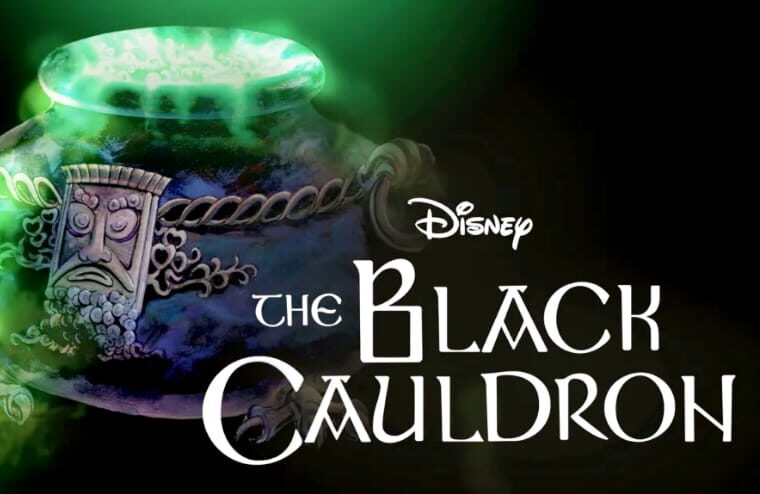
The funny thing about “worst movies ever” is that they seldom gain that reputation based purely on quality or the lack of it. Most of the time, it has something to do with a scandalous or troubled production. I suspect that’s why “The Black Cauldron” is often called the nadir of Disney’s animated features, a claim made ridiculous by the fact that “Chicken Little” and “Wish” exist. I hadn’t seen “The Black Cauldron” since I was a wee child, and I had only positive memories associated with it.
Truth be told, a part of me was afraid that those memories would be tainted by my most recent viewing of the film. Happily, my fears were unfounded. “The Black Cauldron” is a spellbinding animated work that deserves to be alongside the rest of Disney’s classic works. I was genuinely enthralled by its story and blown away by the visual artistry on display. While the two main characters were a little dry, the supporting cast of weirdos makes up for it. If I didn’t know about the tumultuous journey the film had, I wouldn’t have suspected anything.
For better or for worse, this column inadvertently became a series of defenses for maligned and panned movies. All movies have merit, no matter how strange they may seem. To quote Mr. Lobo, “They’re not bad movies — just misunderstood.” But what I don’t understand is how “The Black Cauldron” became so reviled that it must be championed here. After my recent viewing of “The Black Cauldron,” I thought I had misremembered the public reaction to the film. Alas, I remembered correctly. Rotten Tomatoes, IMDB, and the like have shown me just how hated “The Black Cauldron” is among certain cinephiles and animation buffs. Reviews from the last few years are just as venomous as they (supposedly) were back in the 1980s.
It’s very likely that some folks genuinely dislike the movie. Your favorite film is someone’s most hated, and vice versa. Criticisms of “The Black Cauldron” generally boil down to three common points: the dark-for-Disney tone, the aforementioned production issues, and the departure from the source material (“The Chronicles of Prydain” series by Lloyd Alexander). Since I have never read those books, I’m not qualified to comment on that particular matter. But I have thoughts on the other two.
Firstly, it’s undeniable that “The Black Cauldron” is a particularly grisly picture for the House of Mouse. A test screening for the movie had parents and children alike literally running out of the theater. Though the final version has been cut significantly, what remains is still pretty darn gruesome. The Horned King is probably the scariest of all Disney villains, with his decayed appearance and trademark horns. Unlike most Disney villains, there’s no attempt to make him charming or funny. He’s a thoroughly twisted individual intent on destroying all life with his hideous army of deathless warriors. (I love him dearly.) Horned King and his Cauldron Born soldiers are nightmare-inducing. They’re the kind of freaks you’d expect to find on a heavy metal album cover. And without saying too much, it’s safe to say that Horned King’s demise led to hundreds of therapy sessions.
Now, “The Black Cauldron” may be the most intense Disney-branded animated feature, but Disney cartoons have always been on the morbid side. From “The Skeleton Dance” to the Headless Horseman to Facilier, the voodoo master in “The Princess and the Frog,” the best of these works have always acknowledged that children are fascinated by the macabre. Talk to just about anyone with a pulse, and they’ll tell you that their favorite segment in “Fantasia” was the one with all the devils. “The Black Cauldron” upholds the proud Disney tradition of scaring the holy guacamole out of children.
Perhaps the scare factor played a part in “The Black Cauldron’s” downfall back in the day, but we now live in an era where “Return to Oz” is considered a beloved classic. Being relentlessly creepy and aimed at kids almost always guarantees a robust cult following. “Black Cauldron” certainly has its fans and the occasional merch, though it’s fair to say that people who aren’t deeply into animation rarely talk about it. When it does come up, it’s almost always about that accursed production period.
There’s way too much to cover. You could write an entire 500-page book on the making of this movie. Unfortunately, I’m working with a few paragraphs, so I’ll do my best to give you the short-short version. Disney bought the rights to “The Chronicles of Prydain” back in 1971, and pre-production work began in 1973. According to animation legend Ollie Johnston, he and fellow Frank Thomas convinced the studio to buy the rights. They believed that if done properly, it could be
“as good as Snow White.” Because they were adapting a 5-part book series with numerous characters and storylines, several story artists and animators worked throughout the 1970s to condense it into one cohesive narrative. The plan was to release the film in 1980. However, veteran artist Mel Shaw created these elaborate pastel paintings, which were to serve as the project’s blueprints. Then-future Disney President and CEO Ron W. Miller was greatly inspired by these paintings but did not believe the current animators were experienced enough to handle the work. In August of 1978, the project was pushed back to Christmas of 1984.
Too many cooks were in the kitchen, as they say. Artist after artist was attached and then detached from the project. John Musker and Ron Clements (the men who directed “Aladdin,” “The Little Mermaid,” and “The Great Mouse Detective”) were involved and then left due to “creative differences.” A young Tim Burton submitted art that was eventually rejected for being too weird. Internal fights between veteran animators and the new crop of young animators led to even more trouble. Newly appointed Disney studio chairman Jeffrey Katzenberg was horrified by that test screening and demanded that certain scenes be cut. Producer Joe Hale objected to the demands, so Katzenberg brought the film to an edit bay and attempted to edit the film himself. Katzenberg was stopped by the newly appointed Disney CEO, Michael Eisner, but still insisted that changes be made. The release was moved from December 1984 to July 1985.
At one point, holographic projectors were developed to make the undead army appear in theatres. Impressive as it was, the technology was too expensive and was eventually scrapped. Even without the aid of holographic ghouls, the film was scary enough to earn Disney’s first “PG” rating for an animated feature. “Black Cauldron” cost $44 million to produce, making it the most expensive animated film at the time. It took about 14 years for the film to get made. After all that, “The Black Cauldron” was a massive bomb. It was outgrossed by “The Care Bears Movie,” a re-release of “One Hundred and One Dalmatians,” and “Pee-wee’s Big Adventure,” the feature film debut of director Tim Burton.
I do believe that the troubled production of “The Black Cauldron” hurt the movie’s reputation years later. Every negative review either points to the behind-the-scenes drama or the lack of fidelity to the source material. Whether or not it was earned, “Black Cauldron” was always doomed to a poor reputation. Folks know the chaos surrounding the film better than the film itself.
Roger Ebert actually awarded the film 3 1/2 stars out of four. While I don’t always agree with Ol’ Roger, we definitely see eye-to-eye on this one. “The Black Cauldron” is a fantasy gem waiting to be rediscovered. Divorce it from its production and source material. Don’t think of it as a Disney movie in the traditional sense. (There are no musical numbers.) Approach it as a standalone adventure, and you may enjoy the journey. I certainly did.

- The Phibes Philes: The Mummy (2026) – Movie Review - July 7, 2026
- The Phibes Philes: Friday The 13th On The NES – The Misunderstood Video Game Classic - June 22, 2026
- The Phibes Philes: Wishmaster – Movie Review - June 12, 2026