


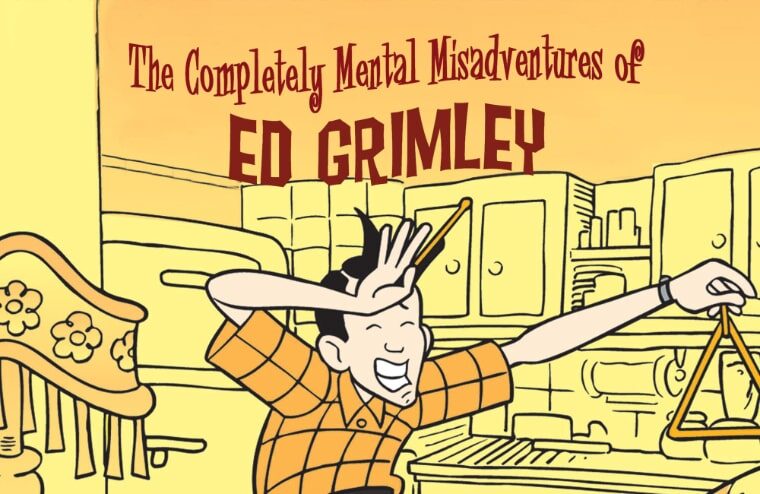
With apologies to all you ardent He-Man and Rainbow Brite fans, the 1980s are part of a time referred to by cartoon historians as the “Dark Age of Animation.” While the studio system was collapsing, the late ’50s saw the fall of the theatrical short and the rise of television cartoons. Limited animation and low budgets dominated this era. Animation studios like Hanna-Barbera relied heavily on voice acting and dialogue for humor, which led cartooning legend Chuck Jones to coin the phrase “illustrated radio.” By the ’80s, cartoons became less about good jokes and more about selling toys. While shorts like “Popeye” and “Looney Tunes” were aimed at all audiences (in fact, the humor usually played better with adults than children), cartoons of this period were strictly for kids, usually with the intent of promoting some toy. That’s not to say that there weren’t any good cartoons made during the “Dark Age,” but it’s fair to say that quality comedy wasn’t the #1 priority. That is until Martin Short: Human Cartoon hitched his pants up to his armpits and valiantly failed to start an animation renaissance.
One year before The Simpsons received their own series and three before Ren & Stimpy made mainstream cartoons weird again, Hanna-Barbera approached Martin Short to develop an animated show based on Ed Grimley, a character Short had played on the classic sketch comedy shows “SCTV” and “Saturday Night Live.” Originally an unnamed parent in a skit for the Second City stage (what SCTV was derived from), Ed Grimley morphed into a cowlicked eccentric when Peter Aykroyd joked about how the height of Ed’s hair would increase with each performance. Short described his creation as an adult with the excitement of a child. In a way, Ed Grimley is not dissimilar to Pee-wee Herman, another man-child created for stage comedy. The primary difference between the two is that Pee-wee is a bowtie-wearing Peter Pan living in a fantasy world, and Ed is just a weirdo who loves boring junk like “Wheel of Fortune” and the triangle. There really aren’t any jokes in any of the original Ed Grimley shorts. He was just sorta strange, which Short portrayed masterfully.
Understandably, Martin Short wasn’t convinced that children would love a middle-aged man who looks up to Pat Sajak. Short turned down the initial offers from Hanna-Barbera. But on one fateful Halloween, Short encountered some trick-or-treating kids dressed as Ed Grimley. That and letters from young fans convinced Short of Grimley’s potential as an icon of children’s television. And lo, “The Completely Mental Misadventures of Ed Grimley” was brought to life in 1988!
In a television landscape ruled by “The Smurfs” and “Gummi Bears,” Short decided that kids needed something stranger. His chief inspiration was “The Rocky and Bullwinkle Show,” which overcame its animation shortcomings with genuinely witty humor that was entertaining to both children and parents alike. “Kids today are quite adept at making sudden leaps in logic and accepting wacky twists of the story, and these slightly bizarre ways of linking the departments together will help make this show different from the standard Saturday morning fare.” That was taken from the show’s production bible, and it sums up the show’s comedic approach. Something mundane turns into something bizarre. When Ed goes to the hospital for a tonsillectomy, he ends up sharing a room with a werewolf. On his way to play Monopoly with his aunt, Ed is sucked up by the same tornado that brought Dorothy to Oz, except he ends up on Dorothy’s farm… which turns into a parody of “Summer Stock.” With its normal-then-weird approach, “The Completely Mental Misadventures of Ed Grimley” feels like the predecessor to Cartoon Network’s “Regular Show.”
What separated “The Completely Mental Misadventures of Ed Grimley” from its children’s television contemporaries is that the jokes were… well, funny! And when I say that, I mean “Ed Grimley” feels like it was created with the genuine desire to make people laugh. Now, that shouldn’t be such a novelty, but such was the state of Saturday morning cartoons. Many shows followed the mechanics of humor without actually doing anything to elicit laughter. Jokes were stale and perfunctory, existing mostly because cartoons were expected to have jokes. Sometimes, there would be a phantom laugh track (already an odd feature for animation) that would laugh at literally nothing! Conversely, the humor of “Ed Grimley” had spark and imagination. Had there been a laugh track, there would’ve been actual punchlines for it to react to. Even the expected limited animation was surprisingly effective in how it captured Martin Short’s frantic movements. This was a cartoon that felt alive. The energy was high, the jokes were inventive, and the Fourth Wall was constantly broken.
Martin Short himself voiced Ed to perfection. His rambling monologues and theatrical bursts of singing are really quite entertaining. Occasionally, Short would appear in the flesh. SCTV alumni Andrea Martin and Catherine O’Hara, along with the great Jonathan Winters, were regular voices on the show. Guest stars include Christopher Guest, Kenneth Mars, Eugene Levy, and Dave Thomas. Inarguably, the cast is a who’s-who of comedy legends. That alone should tell you that “Ed Grimley” was funnier than “The Get-Along Gang.”
In addition to the main mental misadventures, there were two segments: The Amazing Gustav Brothers and Count Floyd. When Ed was seemingly about to be killed, the Gustav Brothers would interrupt the show to explain the science behind Ed’s apparent demise. In live-action bits, the howling vampire TV host Count Floyd (Joe Flaherty reprising his “SCTV” character) would tell scary stories to an audience of bored children. For the inclusion of Count Floyd alone, “Ed Grimley” deserves to be remembered as a classic. It features more Count Floyd than any other cartoon show in animation history!
With a stacked cast and a unique sense of humor, “Ed Grimley” was set to conquer Saturday mornings. ED Grimley dolls, lunchboxes, Halloween costumes, and handheld electronic games were produced to satisfy the obviously high demand that was surely coming. An official Ed Grimley lookalike contest was held and then won by 10-year-old Matt Mitchell from Des Moines, Iowa. “The Completely Mental Misadventures of Ed Grimley” was destined to change the animation industry forever, selling toys and emphasizing strong humor done by comic geniuses.
Except that it didn’t. “The Completely Mental Misadventures of Ed Grimley” was mostly ignored at the time. Some dismissed it as an attempt to compete with shows like “Pee-wee’s Playhouse” and “Hey, Vern! It’s Ernest!”; others thought that it just wasn’t a good idea to base a Saturday morning cartoon around a character who mostly appeared on late-night television. After 13 episodes on NBC, the show ended. Short attempted to sell the show to a different network with hopes of a primetime slot. Alas, “The Completely Mental Misadventures of Ed Grimley disappeared, save for some reruns on Cartoon Network and sister network Boomerang many years ago.
It’s a shame that “The Completely Mental Misadventures of Ed Grimley” never really found its audience. The subsequent success of “The Simpsons” and “Ren & Stimpy” proved that audiences of all ages wanted smart, weird cartoons. “The Completely Mental Misadventures of Ed Grimley” was ahead of its time by exactly one year. It may not have kicked off the animation renaissance, but it was a noble attempt to make cartoons funny again. That’s totally decent, I must say.

- The Phibes Philes: Wishmaster – Movie Review - June 12, 2026
- The Phibes Philes: The Eraser – Batman’s Forgotten Foe - May 27, 2026
- The Phibes Philes: The Ghost Galleon (1974) Film Review - May 17, 2026