

Circus comedy movies are a strange affair. On the surface, they seem like the perfect marriage of subject and genre. Weirdos and oddities made the circus their home, so screen comedians should be a natural fit. The problem is that they are indeed a natural fit. When the Marx Brothers invade the opera or a prestigious college, they are rebelling against something. Their incongruity within high society feels daring and subversive. But you place Harpo among clowns, and he makes too much sense to be funny. “At the Circus” is nobody’s favorite Marx Brothers picture. Though well-liked, “The Circus” seldom receives the same attention as Chaplin’s other work. Martin & Lewis fans rarely bring up “3 Ring Circus”; Doris Day (not a comedian per se but certainly known for her comedic roles) is not remembered for her work in “Jumbo.” Conversely, the horror genre has made memorable use of circus iconography in such films as “Freaks” and “Killer Klowns from Outer Space.” A monster under the big top creates much more conflict than a funnyman at the fair.
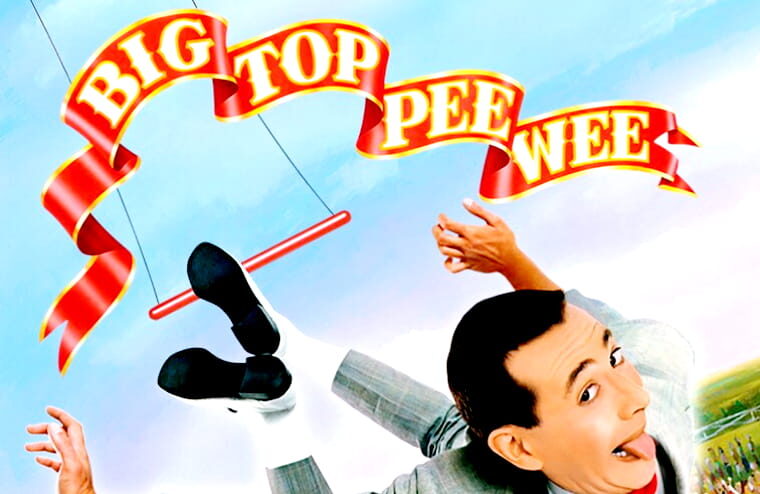
“Big Top Pee-Wee” did nothing to redeem the circus comedy. Truth be told, it probably validates just about everything above. However, I must make a startling confession before I go on: I’m an absolute sucker for anything circus-related. Clowns don’t scare me; they delight me. Trapeze artists fascinate me, and sideshows are everything. Those movies I listed in the first paragraph? I can’t get enough of ’em. With that information, it should come as no surprise that I adore “Big Top Pee-wee.” Pee-wee Herman is one of my heroes, and I’d watch 6 hours of an empty circus tent. I’m the ideal audience for this film. But I can’t say too much in its defense. If I tried, it would boil down to three points: Pee-wee is boss, circuses are cool, and Danny Elfman rules.
To enjoy this movie, I think you really have to enjoy the circus. Everything positive about “Big Top Pee-wee” relies on that atmosphere and vibe. Beyond that, it doesn’t work. I can look beyond my earnest love for the film to see its numerous flaws. None of the jokes really land, Pee-wee’s trademark strangeness seems toned down, and there’s a weird (bad weird) love triangle at the center of it all. In “Big Top Pee-wee,” women just can’t get enough of Pee-wee. Considering that Pee-wee’s appeal is that of a bow-tied Peter Pan who loves toys and gags, the idea of him being with anyone is unappealing. Any attempts to make Pee-wee an actual adult were always doomed to fail. “Big Top Pee-wee” is more mature in tone than any other Pee-wee outing. Perhaps that’s why it’s the only one without a noticeable cult following.
“Pee-wee Herman as Himself” is a documentary series that was released last year. For whatever reason, I just got around to watching it. If you haven’t seen it and admire Paul Reubens as I do, you must give it a watch. Reubens died before the production was complete. For years, he had been secretly battling both myelogenous leukemia and metastatic lung cancer. Not even the filmmakers were aware. The notoriously private Paul Reubens opened up about many things for this documentary: how he’d been in and out of the closet at various times, the scandals that plagued him, and his perfectionist tendencies. Pee-wee Herman had been the persona that dominated his life; this documentary allows us a glimpse into who Paul Reubens really was.
Based on the documentary, “Big Top Pee-wee” seems to be the Pee-wee project that says the most about Mr. Reubens as a person. By his own admission, Reubens felt overshadowed by Tim Burton after the success of “Pee-wee’s Big Adventure.” With this second feature, Mr. Reubens wanted audiences to know that he was the ringmaster of this circus. In a rather unusual move, the teaser trailer featured no footage from the actual movie. Instead, Pee-wee himself addresses the audience, making it clear whose movie it was.
Paul Reubens was born in Sarasota, Florida. It was the winter headquarters for Ringling Bros. and Barnum & Bailey Circus, which was still very much active during Paul’s childhood. His neighbors included the Flying Wallendas and a family of human cannonballs. Show folks of every variety populated the area, and these offbeat denizens informed much of who Paul would become. To the shock of no one, Mr. Reubens even considered joining the circus. He attended circus camp and learned the tricks of the trade.
“Big Top Pee-wee” is very much a love letter to Paul’s boyhood days in Sarasota. Once the show comes to town in the film, every frame really demonstrates his love for that world. As a comedy, it doesn’t work. But as a portrait of a lifestyle and art that inspires a man’s whole career, it is weirdly moving. Mr. Reubens loved circus performers and their idiosyncrasies. When you see his depiction of a traditional circus, things like the wacky characters of “Pee-wee’s Playhouse” really begin to click. All sorts of people (and anthropomorphic furniture in the case of “Playhouse”) from all walks of life are getting together to make something wild and wonderful.
That’s also among the reasons why “Big Top Pee-wee” didn’t win folks over. Despite the depiction of collaboration, many of Paul’s usual cohorts (Phil Hartman and John “Jambi” Paragon) did not contribute to this project. As previously mentioned, Mr. Reubens wanted it to be known that this project was mostly his. Essentially, he was the auteur behind this one. “Pee-wee as Himself” emphasizes that Paul was a perfectionist, a quality that both served him well and sometimes proved a detriment. Mr. Reubens would admit that his desire to control this particular production led to less-than-stellar results. That may hurt it as a comedy, but it may interest people who are interested in Paul Reubens as an artist. Despite its flaws, great effort was made here, and you see the vision of a truly one-of-a-kind artist. For better or for worse, this is the Pee-wee movie that feels the most like Paul’s singular vision.
The darker side of that is the aforementioned love triangle. Paul was out of the closet in his early years, even being in a rather loving relationship with a man named Guy Brown. (In the documentary, it’s revealed that Guy inspired many of Pee-wee’s mannerisms.) Paul broke up with Guy to go back into the closet because he was afraid it would affect his burgeoning career. Guy died of AIDS in the early 1980s, something that seemed to haunt Paul even later on in his life. With this knowledge, it makes me feel a little sad when Pee-wee is forced to be in a heterosexual love triangle. On its own, that element is already bad. But Paul wanted to maintain that image. In his typically playful manner, Reubens basically confirms that critics thought Pee-wee was queer and that the love triangle was an attempt to combat that perception. It’s all very unfortunate, and I wish Paul lived in a time when he could’ve truly felt unafraid to be himself.
Warts and all, I personally love “Big Top Pee-wee.” As a comforting slice of Americana, it’s utterly charming. As a glimpse into the mind of one of our great comics, it’s interesting. Kids may love it, as may circus aficionados. Don’t go in expecting “Pee-wee’s Big Adventure.” It has much more in common with something like “The Greatest Show on Earth” from 1952. Danny Elfman’s score here is among my favorites he’s ever composed. Kris Kristofferson and Susan Tyrrell are delightful as ringmaster Mace Montana and his inch-tall wife. Though most of the humor doesn’t quite reach the expected highs, there’s a gag at the beginning that always makes me chuckle. All in all, “Big Top Pee-wee” is flawed, but it’s still a good time. I’d still run away to join this circus.