


Bela Lugosi had a complicated relationship with Dracula, the role that made him a legend. When Universal began work on their now-classic “Dracula” adaptation (released in 1931), Lugosi wasn’t even their fifth choice for the titular bloodsucker. Even though Lugosi portrayed the role on Broadway to great success in 1927, Universal Studios simply had no interest in the Hungarian actor. But Lugosi campaigned aggressively for the part, refusing to accept “no” for an answer. Finally, Universal relented and allowed Lugosi to play Dracula for a paltry sum of $500 per week. Fellow “Dracula” star David Manners earned $2000 a week for playing Jonathan Harker, a non-vampire whose name is not the title of the story. Still, Lugosi’s gambit paid off. “Dracula” was a bona fide phenomenon, instantly placing Lugosi in the pantheon of great horror actors. It was the greatest thing that ever happened to him; it was also the worst.
Now, if you want my honest opinion, I would say Lugosi had a perfect career, and every actor should envy him. Nearly every role had him as a vampire, mad scientist, maniac, voodoo master, wizard, or ghoul. To me, that’s a dream come true. However, Lugosi craved diversity, and I sympathize. He was a talented actor who was essentially forced to play one role for the rest of his career. Of course, Lugosi was grateful for “Dracula” and the career he had. But at the same time, he felt trapped by a persona that limited the roles he would be considered for. When asked if Dracula ever ends for him, Lugosi responded with the following: “No. No. Dracula never ends. I don’t know if I should call it a fortune or a curse, but it never ends.”
“Every producer in Hollywood had set me down as a type. I was both amused and disappointed,” Lugosi admitted. Because of his accent and Gothic persona, Lugosi was forever the villain. Lugosi could never get a long-term contract at any studio, so he went around playing Mr. Horror for just about anyone. Infamously, Monogram Pictures (among the minor studios of the Golden Age of Hollywood collectively known as “Poverty Row”) hired Lugosi to star in nine thrillers for them. If you have ever owned one of those DVD box sets with about 50 public-domain horror films, you likely owned the complete “Monogram Nine.”
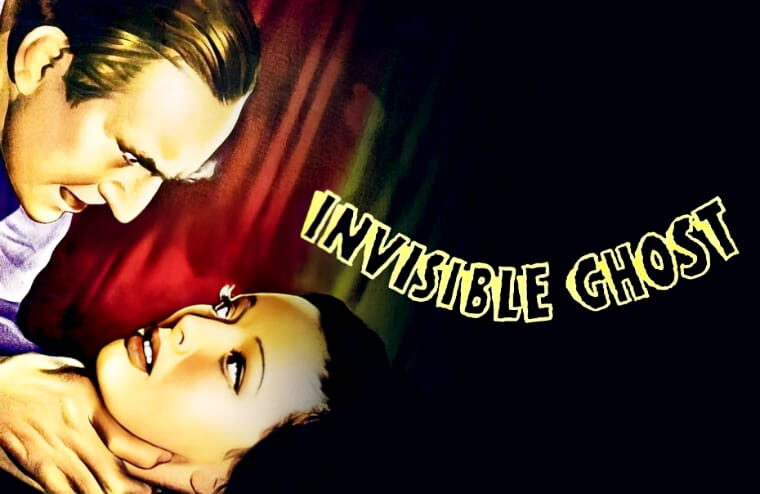
Most folks tend to dismiss those Monogram vehicles. If you wanted to watch a public domain film starring Lugosi, you’d probably put on “White Zombie” and consider no other options. Truthfully, as a life-long Lugosi lover, I’m not sure I had seen all nine of the Monogram/Lugosi fright-fests until recently. I’m not going to argue that any of them are even half as good as Lugosi’s worst film for Universal. On every conceivable level, these are “B” movies. Still, I found myself captivated by these shabby little shockers. At worst, they’re an amusing way to kill an hour. Some of them are actually very entertaining as pulp adventures. Among my favorites was a weird little gem from 1941 called “The Invisible Ghost.”
The first thing you’ll notice about “The Invisible Ghost” is that it has nothing to do with ghosts or invisibility. While I will not count that against the movie, I must admit that is one reason this film was not on my radar. I probably put this one on in the background at some point, but I never gave it my full attention until a few days ago. Instead of the usual supernatural trappings, the plot centers on Charles Kessler, a respected physician who lives in a stately manor with his daughter and servants. He is haunted by his “dead” wife, who (unbeknownst to him) actually survived her supposedly fatal accident, though she has suffered brain damage. Because of this trauma, Kessler transforms into a homicidal maniac. However, the unfortunate Kessler is unaware of this, murdering those around him without any knowledge of his ghastly deeds.
“The Invisible Ghost” is fairly ridiculous in terms of plot. A ghost or Invisible Man would probably be more logical. Yet there is something about the plot that keeps the viewer engaged. Wacky plot elements are part of the appeal of a “B” movie, but the murder plot works in a comic book sort of way. Lugosi bumps off his victims with his cloak, something you don’t see often in these pictures. On the level of a Lugosi cheapie-chiller, it works mighty well. You get Lugosi. You get odd killings. You get a spooky mansion. All that alone warrants a recommendation.
But two elements really stand out. The first being the direction, which is surprisingly dynamic. Director Joseph H. Lewis was a stylist, and his subsequent work has been examined through the lens of auteur theory. “Gun Crazy,” “My Name is Julia Ross,” and “The Big Combo” are all deeply appreciated by the film community for their bold visual storytelling. “The Invisible Ghost” generally isn’t in the same conversation as those three, though it does demonstrate the sort of imaginative filmmaking that made the other Lewis pictures critical favorites. In probably the most striking bit, we see a murder through the eyes of the victim.
The other being the performances, specifically the ones given by Bela Lugosi and Clarence Muse. Muse plays Kessler’s butler, Evans. His performance is charming, funny, and dignified. Lugosi and Muse were friends in real life, so their scenes together convey a natural chemistry. One of the unfortunate aspects of being a fan of Old Hollywood cinema is the inherent racism of the time. Black actors were seldom cast. When they were, it was usually as some terrible stereotype. But Evans is never the butt of the joke or a caricature. Clarence Muse plays him as a real person, and he’s by far the most compelling of the supporting cast.
Of course, Lugosi is the villain of the picture. That was the role assigned to him by Hollywood. As much as I love his monstrous roles, he obviously wanted to play something else. And while Lugosi is ultimately the monster of this picture, he almost gets his wish here. For most of the runtime, Lugosi plays a genuinely kind character. Like I said before, his interactions with Muse are fantastic. We see a warmth and softness from Lugosi that he wasn’t usually allowed to show. Despite being the murderer (he is oblivious to his own crimes), this is one of the few times Lugosi got to be more than just Dracula.
Lugosi once said, “I’d like to quit the supernatural roles and play just an interesting, down-to-earth person.” He probably didn’t have “The Invisible Ghost” in mind, but it comes close to fulfilling his goal. I wish Lugosi had more opportunities to play the kinds of roles he wanted, but I also hope he understood how much his horror roles meant to people. Even today, he is synonymous with a genre that has brought so much joy and the right kind of fear. To guys like me, Lugosi’s roles were more relatable than “just an interesting, down-to-earth person.”

- The Phibes Philes: Wishmaster – Movie Review - June 12, 2026
- The Phibes Philes: The Eraser – Batman’s Forgotten Foe - May 27, 2026
- The Phibes Philes: The Ghost Galleon (1974) Film Review - May 17, 2026