

Greetings, True Believers! It may seem crazy now in a world where three of the top ten highest-grossing films feature Spider-Man and Doctor Strange, but there was a time when superheroes and supervillains did not dominate pop culture. Characters like M.O.D.O.K. and Kite Man have their own shows, so it’s easy to forget what a novelty it was to see any comic star beyond Superman or Batman in any major capacity. Sure, film serials of the ’40s would take a crack at the likes of Captain Marvel, Batman, Mandrake the Magician, and Captain America, but it was still a rare sight to see spandex and capes outside of a circus. Supes and Batsy continued appearing in various media while their brethren were happily contained within the pages of a comic book. But in 1966, something MARVELous happened: “The Marvel Super Heroes” flew onto the small screen! Featuring all your favorite heroes and Namor the Sub-Mariner, this anthology cartoon series was the first time the Marvel characters appeared outside of a comic. That Captain America serial? Marvel was still “Timely” when that was produced. Without this wonderful, barely-animated show, Marvel as we know it today wouldn’t exist.
“The Marvel Super Heroes” was produced by Grantray-Lawrence Animation, headed by Grant Simmons, Ray Patterson, and Robert Lawrence. The studio didn’t do much and it went bankrupt shortly after their Marvel shows (there is another), but you can’t deny what they did for Earth’s mightiest heroes. At this point, the Adam West “Batman” series was already a Bat-smash, so it’s conceivable that this show was made with the intent of cashing in on that success. In that inimitable Marvel fashion, the series was announced in the “Marvel Bullpen Bulletins” of the November 1966 issues. This was the announcement: “It won’t be long before our swingin’ super-heroes make their star-studded debut on TV, appearing five nights a week — that’s right, five — count ’em — five nights a week, for a half-hour each night. So you’ve just got time to make sure your set’s in good working order — check your local paper for time and station — and prepare to have a ball!
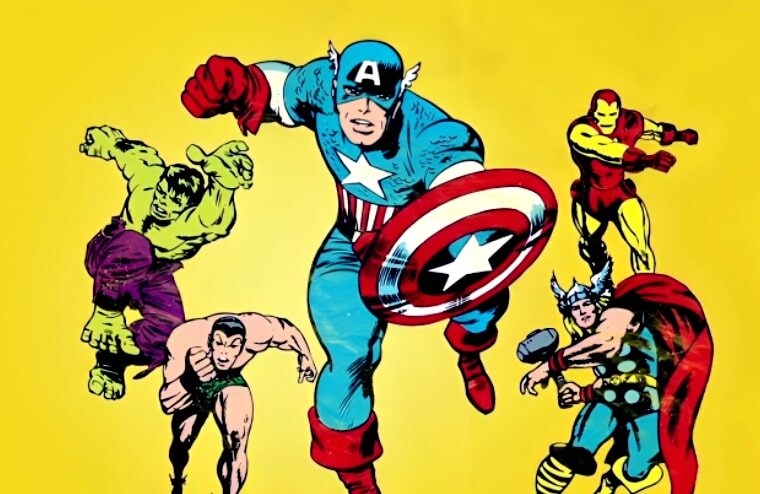
In its initial run, “The Marvel Super Heroes” was aired as a half-hour program that was made of three 7-minute segments starring a particular superhero. The rotating cast of costumed crime fighters included Captain America, Iron Man, Thor, The Incredible Hulk, and Namor the Sub-Mariner. Early promotional material and merchandise suggest that Spider-Man was originally part of the line-up, but we’ll get to that later. Just know that in his place, we got Namor. His three fans were giddy with excitement.
People will often say that a particularly good book adaptation was “ripped” from its pages. In the case of “The Marvel Super Heroes,” this was basically the case. Using the power of xerography, the animation was created using actual panels from the Marvel comics. Entire stories were told as they appeared in print. The catch was that the animation was limited. And not in the way that “The Flintstones” was limited animation. Fred Flintstone was an expressive and fluid figure. That can’t be said for the Marvel Super Heroes, who often struggled to open their mouths. Occasionally, an arm or leg would move. In that regard, it may be fair to say that the show was a bit crude.
That said, there is an irresistible charm to “The Marvel Super Heroes.” The animation was stiff, but you were still looking at some of the greatest art in superhero media. Among the artists showcased were Jack Kirby, Steve Ditko, Bill Everett, Don Heck, and Gene Colan. You had great voice-acting, sound effects, and the theme songs of Jacques Urbont. That last point is especially important because I defy you to claim that they aren’t all bangers. I find myself belting “WHEN CAPTAIN AMERICA THROWS HIS MIGHTY SHIELD…” at random times. Those songs, that art, and the overall atmosphere is everything I love about superheroes: earnest, silly, and magnificent. You can keep “Endgame.” Make mine “Marvel Super Heroes.”
Because the art was taken straight from the comics, you had appearances by some of the other major Marvel players. The Wasp, Giant-Man, Scarlet Witch, Black Widow, Doctor Doom, and Kraven the Hunter are just a few of the unexpected guest stars. Though I am partial to The Wasp myself, the most notable guest stars are probably the original X-Men. The merry Mutants debuted their animation before Wolverine even existed in the comics. This line-up consisted of Angel, Beast, Cyclops, Iceman, and Marvel Girl/Jean Grey. Strangely, the X-Men were not named such here. Instead, they were the “Allies of Peace.” They appear in an adaptation of Fantastic Four #6, replacing the Four. Hanna-Barbera owned the rights to Fantastic Four (their cartoon came out a year later), so the “Allies of Peace” had to fill in.

- The Phibes Philes: Wishmaster – Movie Review - June 12, 2026
- The Phibes Philes: The Eraser – Batman’s Forgotten Foe - May 27, 2026
- The Phibes Philes: The Ghost Galleon (1974) Film Review - May 17, 2026