

I want you to think of an iconic horror villain from the 1980s. You could have thought of a myriad of creeps from a wide variety of chillers. Though I’m not the betting sort, I’d wager at least half of you came up with either Freddy Krueger or Jason Voorhees. Maybe a good portion of readers pictured Pinhead. And if your tastes skew towards the odd, you may have imagined Herbert West from “Re-Animator” or Angela Baker from “Sleepaway Camp.” Monster lovers probably conjured Pumpkinhead or The Predator. Heck, some of you probably considered The Terminator. All these potential candidates and more could’ve entered your mind. But with a supreme level of certainty, I guarantee none of you thought of The Warlock from “Warlock.”
Just barely making the same decade as “A Nightmare on Elm Street” and “Friday the 13th,” “Warlock” (directed by noted genre director Steve Miner) was released in 1989, though it didn’t see release in the US until 1991. Many say that the horror genre was in a slump at the time, but the late ’80s gave us many interesting gems worth your time. “Warlock” is chief among them. It’s the kind of mid-budget oddity that doesn’t really exist in the streaming era. While it didn’t quite reach the heights of the previously mentioned franchises, it did spawn a modest series with two sequels, a novel, a comic book, and a video game.
“Warlock” starts with a sequence that recalls Mario Bava’s “Black Sunday.” A warlock–specifically The Warlock–is sentenced to death in Boston, Massachusetts, in the year 1691. Witch-hunter Giles Redferne holds the Warlock in captivity, eager to punish the evil one for his many crimes, including the murder of Redferne’s wife. However, before justice can be served, Satan propels The Warlock to the most unholy of places: 1980s Los Angeles. Redferne follows his foe into the present through a portal. Immediately, The Warlock crashes through the house of waitress Kassandra and her roommate Chas.. (Do not get attached to Chas. The Warlock immediately bites out his tongue and kills him.) Shortly after, The Warlock uses a fake medium to summon Satan, who tells him to reassemble the Grand Grimoire, a book divided into three pieces that can unmake Creation. Ripping out the medium’s eyes, The Warlock uses them as a compass and begins his unholy quest.
And that all happens relatively early in the movie. In its own way, “Warlock” is something of an epic. There are spells, weird special effects, and a mad dash to save the world from destruction. (All of this to a score by the legendary Jerry Goldsmith.) Critics often compare it to “The Terminator,” which isn’t entirely inaccurate. But “Warlock” certainly has its own flavor, preferring D&D-style fantasy to “Terminator’s” cyberpunk sci-fi.
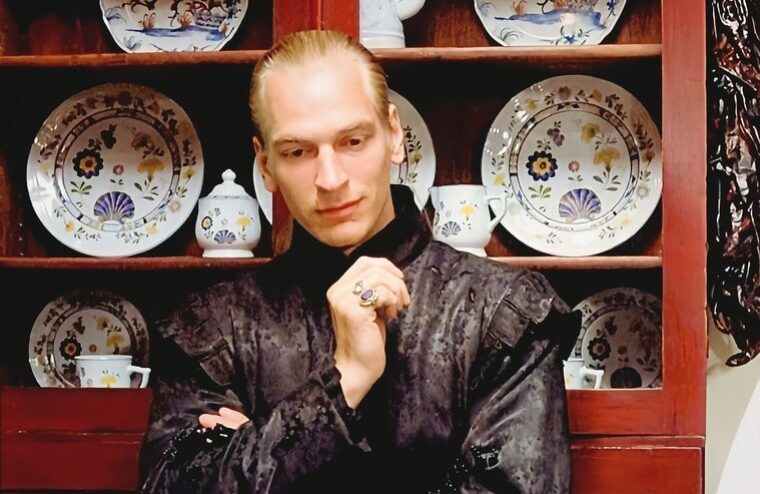
I love “Warlock for many reasons, but two stand out above the rest: Julian Sands and Richard E. Grant. Sands is the titular Warlock, and Grant is Redferne. Both play their parts with a Shakespearean gravity. Sands reportedly passed on the part because he thought it was a standard slasher. In an absolute victory for all of mankind, the script won Sands over, and he created a wonderfully wicked Warlock. His rivalry with Grant (who genuinely gives the impression of a man from a different time) reminds me of the great battles between Christopher Lee and Peter Cushing in the Hammer Dracula series. Lori Singer plays Kassandra with less weight, though there is a uniquely 1980s charm to her.
Unfortunately, there is an unpleasant side to the history of “Warlock,” though it’s no fault of the creators. In 1996, a 14-year-old boy killed a 7-year-old acquaintance and boiled his skin, imitating an act committed by The Warlock. During the trial, the murderer’s lawyer argued that his client was obsessed with “Warlock” and that the crime was inspired by the occult acts depicted in the movie. This heinous act sparked a debate about violence in movies in Canada and reportedly led to the country’s decision to censor cable television violence via the V-chip.
As previously mentioned, “Warlock” inspired something of a franchise. Sands returned for the second installment, but I’d argue the only one you need to watch is the first one. Screenwriter David Twohy’s script is full of clever and gruesome ideas, even if the final version goes against his original concept of The Warlock as a tragic figure persecuted by zealots. Some aspects are dated (the way homosexuality is discussed is very much of its time), though the horror-fantasy plot remains entertaining, mainly. The late, great Julian Sands as The Warlock is a horror villain worthy of rediscovery. May his beautiful wickedness never be truly destroyed.

- The Phibes Philes: Wishmaster – Movie Review - June 12, 2026
- The Phibes Philes: The Eraser – Batman’s Forgotten Foe - May 27, 2026
- The Phibes Philes: The Ghost Galleon (1974) Film Review - May 17, 2026