

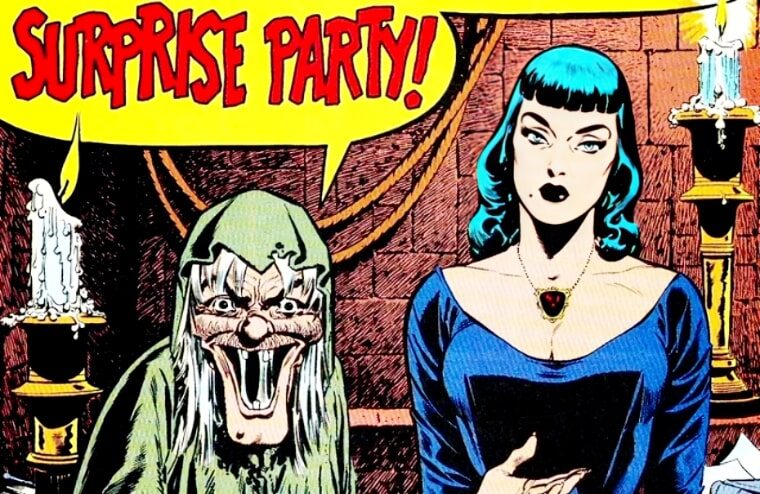
In that brief period in the 1950s before a loud public outcry against fun led to self-censorship in the comic industry, the #1 heroes in comics were not caped crusaders but hideous little ghouls known as “horror hosts.” The job of the horror host is right there in the title: they host horror. Before the start of some tawdry tale of terror, the horror host would crack wise and take revolting relish in the terror that was about to unfold. Sometimes they were drooling corpses who stuck around long after their expiration date; maybe they were a buxom vampiress looking for a bite to eat. Werewolves, mad scientists, witches, warlocks, and creatures from all walks of (after)life have taken up the mantle of horror host. As far as I can tell, the only thing any monster needs for the position is a gleeful sense of sadism and the ability to tell a killer story.
So many horrible (complimentary) horror hosts have spun their yarns over the years, so this list proved far more challenging to compile than I initially anticipated. To keep things relatively simple, I limited myself to characters who originated in comics. Boris Karloff, Vincent Price, Elvira, Bela Lugosi, and Rod Serling are all technically comic book hosts, but they won’t be included here. For the rest, if I left some ghoul or demon off the list, that doesn’t mean they weren’t worthy. Marvel’s Headstone P. Gravely, and Dr. Death from This Magazine is Haunted were on several drafts of this list before it was finalized. Those who made the cut are either those who most strongly represent this genre or ones I dig like a grave. Many of these characters are similar in role and personality, which also made it hard to pick. As much as I adore this shtick, it was difficult to decide who was the best at it. Telling a bad pun about ghastly things is a form of art, and these putrid Picasso-s are among the best ever to do it. And now with that out of the way, here come the creeps!
10. Mr. Crime
First Appearance: Crime Does Not Pay #24 (1942)
In a shocking twist worthy of these morbid magazines, the first horror host in comic books… was not a horror host. Mr. Crime–the spectral storyteller of Crime Does Not Pay comics–set the template that would be used by all future creeps in his field. Armed with a caustic sense of humor and sporting a shiny set of fangs, the ghostly Mr. Crime was a true innovator in revolting raconteuring. Every single ghoul on this list owes their afterlife to this spinner of sinister yarns.
If Mr. Crime was so influential, why is he so low on the list? Well, as I mentioned previously, the venerable villain wasn’t actually a horror host. While Crime Does Not Pay certainly played with macabre elements, most of these tales were straightforward crime stories. Horror was not the primary genre. Still, a cackling ghost with a razor-blade smile certainly deserves a spot here.
9. Drusilla
First Appearance: The Vault of Horror #37 (1954)
Good Lord! *choke* It’s the first appearance of EC Comics on this list (but far from the last)! Drusilla looks an awful lot like TV horror host Vampira, who debuted the very same year. Did one influence the other? In my opinion, probably not. But both were ahead of the curve when it came to ghoulish glamour. Drusilla’s vampiric beauty anticipated the goth movement by decades.
Not much is known about Drusilla. She didn’t speak, and she only appeared in the last few issues of The Vault of Horror as the Vault-Keeper’s assistant. Intriguing as she was, that air of mystery which makes her memorable is also the reason why she’s low on the list. We never got the chance to really know Drusilla. If the comic book witch-hunt didn’t kill off the EC horror comics, Drusilla may have been a bona fide star. However, even with just four issues, she’s still worthy of her place among the top comic spooks.
8. Destiny
First Appearance: Weird Mystery Tales #1 (1972)
Destiny Destiny! No escaping that for me! Of all the GORY-tellers here, Destiny stands out as the most ominous. Most of these cats are jokesters, femme fatales, or both. Our hooded host, Destiny, took his duties seriously, making him sort of an oddity among his peers. The blind seer would tell tales of terror from his tome that contains the past, present, and future. His cryptic nature makes him far more haunting than the average host, though arguably less endearing. Unfortunately, even Destiny cannot escape his fate. He was eventually replaced by Eve, a wisecracking witch who was much more typical of what you would expect from these books. Though Eve was more amusing, Destiny was the rare straight man in a genre dominated by smart alecks.
Here we see the beginning of an interesting trend that will continue through this list: Vertigo’s Sandman. The critically-acclaimed comic series made surprising use of horror hosts from the DC Comics Library. The house that Superman built probably has a larger quantity of quality horror hosts than any other publisher, and the majority of them were players in Sandman. Destiny himself was the oldest of the Endless, a group of seven siblings representing some fundamental aspect of the universe. He would even receive his own series. I suppose it was his… destiny.
7. Madame Xanadu and The Phantom Stranger
First Appearance of Madame Xanadu: Doorway to Nightmare #1 (1978)
First Appearance of The Phantom Stranger: The Phantom Stranger #1 (1952)
Okay, so I’m cheating a bit here. For most of these entries, if I lump multiple characters together, it’s because they’re closely associated. However, in the case of Madame Xanadu and The Phantom Stranger, I simply couldn’t decide between the two. Both are unconventional horror hosts in that they often are active participants in their tales, even if it’s in a minor capacity. Both are more associated with DC Superheroes, though their horror roots cannot be denied.
Madame Xanadu gave tarot readings to clients and sent them on supernatural journeys. The Phantom Stranger remains mostly mysterious, which is unusual for a character of his longevity. His early stories involved debunking the supernatural before he became a genuine occult figure. These two enigmatic characters would serve as the catalyst for a paranormal fable, making them the spirit hosts of horror. You may contest their inclusion on this list, but these two represent both the supernatural side of DC Superheroes and a unique approach to the horror anthology format.
6. The Three Witches
First Appearance: The Witching Hour #1 (1969)
By the pricking of my thumbs, something wicked this way comes! Witches have long been integral members of the horror host tradition, dating back to the early days of radio chiller shows. We’ll see a few more later on, but now I must draw your attention to the Three Witches: Mordred, Mildred, and Cynthia, designed by Alex “Space Ghost” Toth, the Three Witches are three witch (‘natch) sisters who try to outdo each other by telling the scariest story. Their contrasting appearances and amusing dynamic would make them contenders for this list if that were all they had.
But like Destiny, the Three Witches were resurrected by the Sandman series. Before, they were mere witches. After Sandman, they represented the concept of the Triple Goddess: Maiden, Mother, and Crone. Now they are deities who have crossed paths with the likes of Wonder Woman and Justice League Dark. They’ve even been known to work their magic on Harley Quinn.
5. Sabrina the Teenage Witch
First Appearance: Archie’s Madhouse #22 (1962)
First Appearance as a Horror Host: Chilling Adventures In Sorcery As Told By Sabrina (1972)
Sabrina is the supernatural’s answer to Barbie: she’s been in every role, every environment, and manages to fit in beautifully every time. In the many decades since her debut, the sorcerous Sabrina has starred in slapstick comedies, romances, Saturday morning cartoons, Satanic thrillers, Exorcist-esque horror, superhero adventures, and crossovers with everyone from Sonic the Hedgehog to The Predator. And it always works! Considering all that, it really isn’t surprising that Sabrina played the role of a horror host. Chilling Adventures in Sorcery didn’t last long in the grand scheme of things, and Sabrina’s stint as hostess was even shorter. Her career in storytelling came to an end after just two issues.
In all fairness, Sabrina should be lower on this list. However, I truly believe the part was perfect for her. Corn-on-the-macabre humor and charismatic witches are two major staples of this genre, both being defining attributes of Sabrina herself. And despite being done in the Archie house style, the stories themselves were pretty dark. Straight-up horror told by a spooky comedy icon. Since Archie has rebranded themselves as a horror publisher in recent years, it’s time to let Sabrina tell her tales from the cauldron once again.
4. Vampirella
First Appearance: Vampirella #1 (1969)
Like Sabrina, Vampirella is a character you’ve probably heard of outside of this genre. Hailing from the planet Drakulon (in most versions), Vampirella is the scantily-clad superheroine created by beloved monster nerd Forrest J. Ackerman and pioneering feminist cartoonist Trina Robbins. Since her inception, Vampirella has been a remarkably popular character in comics and among the most enduring bombshells in her medium. Though primarily known more for her design, Vampirella has been in a plethora of B-movie-like comics that are most definitely worth reading. While they generally skew towards action and sci-fi, Vampirella is a notable figure in the horror anthology.
Warren Publishing was responsible for Vampirella, and her comic was meant to be a sister series to Creepy and Eerie (more on those in a bit). As you would expect, Vampirella would tell yelp-yarns and do all the things expected of a horror host. These stories were in the EC mold and often quite excellent, but what separated Vampirella from the others was that she would star in at least one story per issue. In that regard, she’s sorta like Madame Xanadu and the Phantom Stranger. Vampirella remained a host until Issue #8 before leaving the storytelling game to become a full-time superheroine.
3. Uncle Creepy and Cousin Eerie
First Appearance of Uncle Creepy: Creepy #1 (1964)
First Appearance of Cousin Eerie: Eerie #1 (1966)
Alluded to briefly in my opening paragraph, the public outcry against comics in 1954 led to the temporary end of traditional horror in the medium.Self-censorship in the comic industry essentially made it impossible to do an EC-style story. Gore, monsters, and gruesome punishments were out; superheroes were in. For many years, horror titles were either softened or phased out. Comics like House of Mystery were striped of their scares; superheroes like Martian Manhunter became the headliners. They were victims of the self-imposed Comics Code Authority, which sought to appease the Ned and Maude Flandereses out there. Comics had to be reviewed by the Comics Code Authority and receive its official Seal of Approval. Though not mandatory, most distributors refused to carry a comic that did not carry the seal. To publish a comic book without it was to commit commercial suicide. However, no such restrictions were imposed on magazines.
Creepy Magazine and later Eerie Magazine are responsible for half of this list. Within the magazine format, they were allowed to bring back the magnificent malice and monsters that made these books popular in the first place. Their success and the gradual weakening of the Comics Code Authority ushered in a new dawn of anthology horror. Uncle Creepy and Cousin Eerie opened the coffin for the Three Witches, Destiny, and two others we’ll get to in a moment. On top of that, the gruesome twosome was gorgeously gruesome in design. It just doesn’t get much better than Creepy and Eerie. That said, we still have two more spots left…
2. Cain and Abel
First Appearance of Cain: The House of Mystery #175 (1968)
First Appearance of Abel: DC Special #4 (1969)
By their historical significance alone, I should probably have put Uncle Creepy and Cousin Eerie in this spot. However, of all the Crypt-Keeper/Vault-Keeper imitators we’ve had over the years, none of them amuse me more than Cain of the House of Mystery and Abel of the House of Secrets. Depending on the comic you read, they’re either the biblical Cain and Abel or just two chuckleheads who happen to have those names. Either way, they just work. Cain is thin and maniacal; Abel is round and gentle. Imagine if Abbott and Costello were monsters themselves and you have Cain and Abel. Cain routinely tortures the stuttering Abel, leading to some wonderfully wicked slapstick. Though, to keep things fair, Cain often ends up getting punished somehow. The two are also kind and even pleasant to children and superheroes (Cain teamed up with Superman once), though Cain will still imprison ordinary folks in his television set for kicks.
Cain and Abel appeared in Swamp Thing and (you guessed it) Sandman in a way that plays up their biblical connection. In Swamp Thing, Cain was given the classic line, “I invented murder!” It’s interesting to see how the pair can be incorporated into a dramatic setting while still maintaining their horror host personalities. They’ve appeared in cameos and even had roles in the television shows “The Sandman” (Netflix) and “Lucifer.” On a special Halloween episode of “Justice League Action,” Cain and the House of Mystery appeared. Since DC has been producing so many shows based on their comics, I propose they adapt House of Mystery and/or House of Secrets in the style of HBO’s “Tales from the Crypt.” Speaking of which…
1. EC GhouLunatics
First Appearance of the Crypt-Keeper: Crime Patrol #15 (1949)
First Appearance of the Vault-Keeper: War Against Crime #10 (1949)
First Appearance of the Old Witch: Vault of Horror #16 (1950)
There was no other option for #1. Mr. Crime aside, the rest of these cats wouldn’t even exist without the Crypt-Keeper, Vault-Keeper, and the Old Witch. In ways both great and terrible, these three and the stories they told had a profound impact on the comics industry. Superman and Batman are arguably the only ones with a greater impact. Tales so twisted, they broke the comic industry in 1954. Those who came after borrowed their style, their puns, and their mordant sense of irony, but no one has ever come close to the GhouLunatics. When it comes to comic horror, they’re the Beatles. Often imitated, never replicated. It’s no exaggeration to say that comics would be radically different if they didn’t exist.
On the page, they are all equals. But the Crypt-Keeper transcended his already impressive role in pop culture years after the comics ended. First, it was with an appearance in the 1972 “Tales from the Crypt” movie from Amicus, and then with the hit HBO show that aired from 1989 to 1996. There was a time when the Crypt-Keeper was inescapable. Our Master of SCARE-emonies appeared in big Hollywood movies like “Demon Knight” and “Casper.” Toys were made in his likeness; Universal Studios made him their Halloween mascot for a few years. He was in commercials; the first episode of “Goosebumps” was hosted by him. Heck, there was even a cartoon and game show centered around Ol’ Crypty. If not for pesky legal nonsense, he would probably still be one of the top dogs in horror.
On that note, I conclude my somewhat arbitrary ranking of horror hosts in comics. To be perfectly honest, there isn’t a horror host I don’t like in one way or another. Stories need storytellers, and these fable-freaks are the right weirdos for the job. Horror hosts embody (and embalm) everything I personally love about the genre. They find the joy in the grisly; they put the “fun” in funeral.
Good night, fright fiends! May all your nightmares come true!

- The Phibes Philes: Wishmaster – Movie Review - June 12, 2026
- The Phibes Philes: The Eraser – Batman’s Forgotten Foe - May 27, 2026
- The Phibes Philes: The Ghost Galleon (1974) Film Review - May 17, 2026