


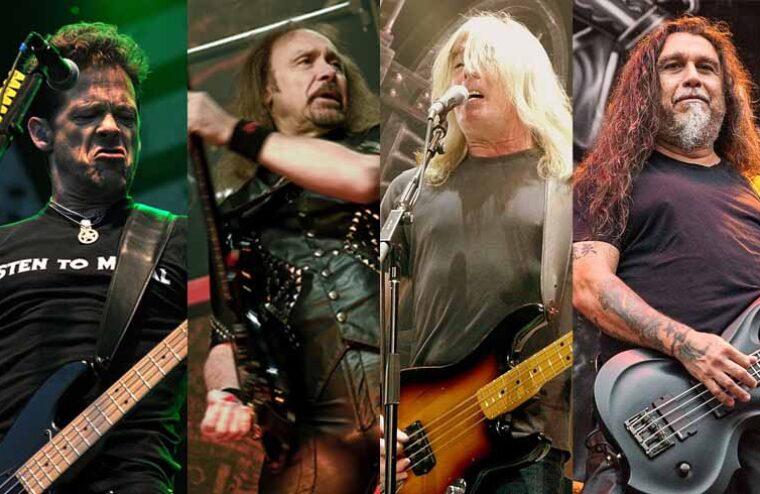
Bass guitar doesn’t get a lot of love in the rock and metal worlds. In the hierarchy of what musicians are considered most important within a band, it usually ranks singer, guitarist, drummer, keyboardist (if there is one), and lastly, the bassist.
Memes and jokes ripping on bass players circulate on social media like their own sub-genre of low-frequency ribbing. It doesn’t help matters when some of the most iconic rock and metal bands of all time bury their bass deep in the mix.
While it’s understandable that the bass guitar is a supporting role in many instances, metal fans shouldn’t need high-priced, noise-canceling headphones or a state-of-the-art hi-fi stereo system to pick it out in a song. With many of the albums by these four bands, that’s exactly the case.
What makes things even more confounding is many peers of these bands are actually quite good at making sure the bass stands out in their mixes without overpowering anything else. Guns N’ Roses, Iron Maiden, KISS, Van Halen, Megadeth and Motörhead all come to mind as groups you rarely have to struggle to hear the bassist. Metal pioneers and forefathers Black Sabbath have one of the best and most well-heard bass players of all time in Geezer Butler. So why did it become such an issue for four of the best bands ever?
Though we still love them all regardless, here are four of the biggest offenders in keeping the bass guitar buried.
Metallica
For a band that has sported three of the best bassists of all time, it’s fairly shocking how much you have to strain to hear bass in Metallica songs. From their beginnings, and even with arguably the greatest metal bassist of all time in Cliff Burton, it’s a struggle to hear the four-string on many of the band’s most iconic tunes (think “Master of Puppets,” “Creeping Death,” “One.”)
Jason Newsted joined the group, cut a bass-audible covers EP, then promptly had his entire performance cut from his first record (“And Justice … For All”). Poor dude nearly quit the band because of it.
Robert Trujillo, one of the most talented bass players on the planet, started recording with Metallica on 2008’s “Death Magnetic.” Much like Burton, he’s buried so low in the mix it’s hard sometimes to tell he’s even there. It didn’t get much better with a subsequent album (“Hardwired… to Self-Destruct”), but they did give him a much better spot audibly for “72 Seasons”, with great results.
Albums with the most audible bass sound: “Kill ‘Em All,” “The Black Album,” “Load,” “72 Seasons.
AC/DC
Angus and Malcolm Young are the core of the AC/DC sound, no doubt. But until Cliff Williams arrived for 1978’s “Powerage,” I’m not sure the brothers really gave the bass a second thought.
Bassist Mark Evans plunks around on the group’s early albums but is barely audible on records like “Dirty Deeds Done Dirt Cheap” and “Let There Be Rock.” Evans revealed in his autobiography that early on producer George Young, Angus and Malcolm’s older brother, wrote many of AC/DC’s bass parts. It’s rumored that it’s actually him jazzing up the song “High Voltage” since it features a much busier bass line than all early AC/DC tunes.
Later on, Williams basically got buried, too, specifically on the “Fly On The Wall” album, which is a shame, because live versions of the material actually reveal some of his most interesting bass work.
While Williams is slightly more prominent on the “Highway To Hell” and “Back In Black” records (and on their more recent efforts) he’s usually had to take an audible backseat. Angus and Malcolm also often instructed Williams into some very basic bass parts that in a way became a staple of the band’s sound.
Albums with the most audible bass sound: “Powerage,” “Highway To Hell,” “The Razors Edge,” “Power Up.”
Slayer
Slayer frontman/bassist Tom Araya sure sounds awfully pained in a lot of his iconic screams. Maybe that agony comes from a completely inaudible bass tone. Someone cut together a YouTube clip of every time he said “death” in a song with hilarious results, and while Slayer sings a lot about death and dying, the only thing they really made sure to kill was his bass in the mix. Outside of the band’s early material, it’s honestly hard to think of many Slayer songs where you can hear and/or remember the bass line. Ironically, the Slayer album least liked by fans, “Diabolus In Musica,” is the one where you can hear Araya’s playing the most clearly.
Albums with the most audible bass sound: “Hell Awaits,” “Haunting The Chapel EP,” “Diabolus In Musica.”
Judas Priest
Much like Cliff Williams in AC/DC, Judas Priest bassist Ian Hill is a study in unselfish support. No one is expecting Hill to have bass solos on a Judas Priest album these days, but they sure didn’t give him much love come mix time on a lot of their records. Judas Priest isn’t as egregious as Slayer or Metallica have been at times with their bass volume — you still are able to pick it out even when it’s lower in the mix — but it’s odd how Hill’s levels took a backseat once the band hit their leather-wearing peak in the early ’80s. It was nice to hear him filling things out nicely again with their most recent effort, “Firepower,” and by the sound of the first two singles, it seems like he’ll be up more in the mix for the forthcoming “Invisible Shield” album, too.
Albums with the most audible bass sound: Pretty much everything prior to “British Steel,” “Nostradamus,” “Firepower.”